
Most Effective Ways for B2B Lead Generation through AI Automation: Proven Strategies for 2026
While traditional outreach methods yield diminishing returns, UK market leaders have shifted focus toward algorithmic precision to dominate the lead acquisition process. AI-driven digital marketing agencies in the United Kingdom now power B2B lead generation by replacing high-volume “spray and pray” tactics with data-centric exactitude. British enterprises deploy artificial intelligence to automate manual research, isolate high-intent buyers, and disseminate hyper-personalised content at a scale previously unattainable for human teams.
B2B companies face intensifying pressure as sales cycles elongate and competition strengthens. Sophisticated buyers demand relevance, forcing marketing teams to abandon outdated tactics. Consequently, the search for effective automation strategies has dominated growth initiatives across London and beyond. Artificial intelligence functions as the essential infrastructure for modern sales success rather than an optional add-on.
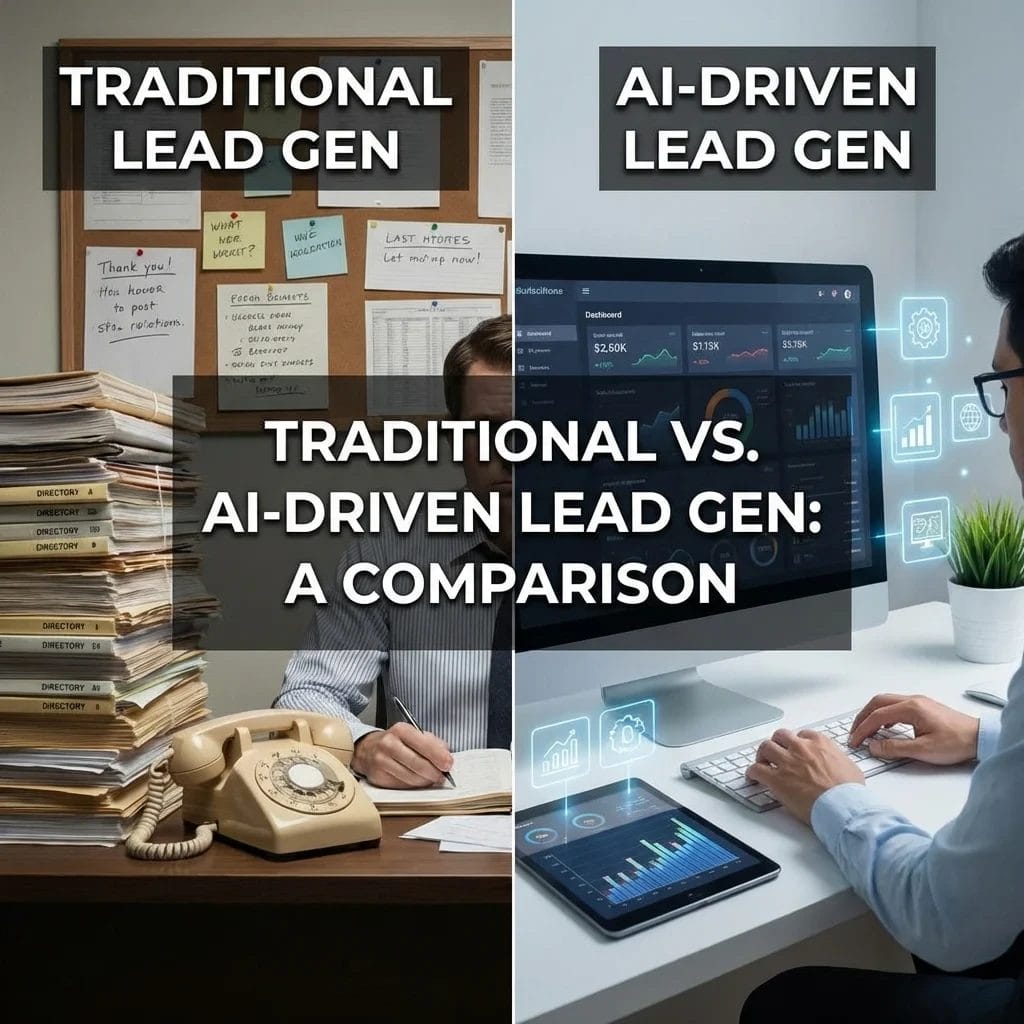
Why Traditional Lead Generation Is Failing
While AI offers precision, traditional lead generation struggles because the modern buyer has evolved beyond the capabilities of static sales scripts.
- Digital Fatigue and Scepticism: Prospects encounter thousands of digital ads and unsolicited messages daily. This saturation triggers a defence mechanism where buyers instinctively ignore generic outreach.
- Information Symmetry: Sales representatives previously controlled information, but today’s buyers conduct 70% to 80% of their research independently. This shift renders traditional “educational” gatekeeping obsolete.
- The Rise of Privacy and Friction: Strict data privacy laws, including UK GDPR, combined with a general dislike for gated content, make lengthy forms a barrier rather than a value-add.
- Quality over Quantity: Legacy methods prioritise “MQLs” (Marketing Qualified Leads) based on simple clicks rather than genuine intent. This approach bloats pipelines with unqualified contacts, wasting valuable sales resources.
Core Mechanisms of AI-Driven Lead Generation

Recognising the failures of legacy methods allows us to see how AI automation alters the sector for B2B survival. Traditional lead generation prioritised volume, whereas AI shifts the strategic focus toward intent and precision through several primary mechanisms.
1. Automated Data Enrichment & Hygiene
Clean, enriched data facilitates superior targeting and reduces wasted marketing spend. A Forrester study established that companies using AI-driven data witnessed 10% higher conversion rates and 30% shorter sales cycles on average. Poor data hygiene remains a primary barrier to success; however, data quality is critical as poor CRM hygiene is the leading cause of AI failure in UK SMEs.
Real-world application: Built In, a digital platform for tech professionals, deployed automated data enrichment to maintain daily updates for its database of 100,000+ accounts. “Apollo enriches everything we have… we don’t really have to touch it, it just works,” noted Built In’s VP of RevOps. This reliable stream of accurate lead data enabled the team to segment opportunities effectively, contributing to an increase of over 10% in win rates.
Primary benefits:
- Eliminate outdated contacts in CRM systems to prevent bounce-backs and GDPR compliance risks.
- Target outreach precisely based on accurate, real-time firmographic data.
- Segment audiences effectively for Account-Based Marketing (ABM) campaigns.
2. Predictive Analytics & Lead Scoring
Predictive analytics transforms prospecting from a reactive task into a proactive strategy. Algorithms analyse massive datasets-incorporating firmographics, website behaviour, and historical interaction-to rank prospects based on conversion probability. This computational filtering enables sales teams to concentrate resources on leads with the highest propensity to buy. Recent data indicates that UK B2B marketers implementing AI tools report 44% higher productivity and improved ROI compared to traditional methods.
Real-world application: Microsoft implemented an AI-based lead scoring system to prioritise sales-ready opportunities. By analysing behavioural and demographic signals, the AI model re-ordered lead queues so representatives focused on the best prospects first. The conversion rate of leads to sales-qualified opportunities quadrupled from 4% to 18% after adopting AI-driven scoring.
3. Intent Data Analysis
Agencies leverage AI to monitor “buying signals” across the web, such as a prospect researching competitors or downloading specific whitepapers. Platforms like 6sense and Bombora identify “in-market” accounts before they submit a contact form. This proactive identification is mandatory in the UK market, where 75% of businesses are now using or exploring AI to power operations, necessitating faster competitive responses.
Demandbase, a B2B marketing tech firm, achieved substantial pipeline growth by leveraging intent data. By identifying in-market prospects and tailoring outreach at the optimal moment, Demandbase qualified $3.5 million in new pipeline in a single quarter. Sales copilots and AI agents now deliver up to 9x ROI for outbound prospecting engines by focusing energy where it counts.
4. Hyper-Personalisation at Scale
Personalisation remains the cornerstone of engaging modern buyers, and AI now renders it scalable. Unlike standard templates, AI scans a prospect’s LinkedIn profile or a company’s annual report to construct bespoke emails that resonate on a human level. UK marketing sectors report that AI-assisted content creation can increase output by over 50%, allowing teams to maintain high-quality personalisation without increasing headcount.
Real-world application: Smartling, a B2B translation SaaS company, utilized Apollo’s AI “Power-Ups” to automate prospect research and email personalisation. This strategy enabled their sales team to transmit 10× more personalised outreach emails than before, increasing productivity. By offloading tedious lead research to AI, sales development representatives (SDRs) scaled their outbound efforts without sacrificing quality.
Conversational AI: The New “Agentic” Layer
Conversational AI functions as the primary “agentic” layer within the B2B sales architecture, transitioning systems from simple question-answering bots to autonomous reasoning engines. These digital agents qualify prospects and drive conversions by interpreting intent rather than following rigid scripts.
From “If-Then” Bots to Contextual Agents
The progression from static decision trees to fluid language models represents a definitive advance in automated customer interaction. Traditional chatbots operated on brittle, pre-defined paths that failed when faced with ambiguity. Modern Conversational AI utilises Large Language Models (LLMs) to parse the semantic nuance of B2B inquiries. Market data confirms this trajectory, as the UK conversational AI market is projected to reach approximately $3.8 billion by 2030, driven by the necessity for smarter, scalable client interactions.
Multi-Turn Reasoning Capabilities
Sophisticated reasoning capabilities enable these agents to manage complex dialogue flows without losing the conversational thread. Agents process multi-part technical queries-such as explaining API integration latency for Australian users while simultaneously calculating regional pricing-without requiring the user to restart the inquiry.
Persistent Memory Protocols
Retaining context across disjointed sessions allows the system to build a cohesive profile of the prospect over time. These systems recall specific details from previous interactions, ensuring that if a lead returns days later, the dialogue resumes without repetition. This continuity is mandatory for modern engagement, as 82% of UK marketers report that customers now expect back-and-forth conversations rather than one-way broadcasts.
Real-Time Lead Qualification & Results
Instantaneous data analysis transforms the qualification process from a passive wait time into an active, real-time assessment. The “form-less” funnel captures and verifies lead data dynamically during the chat, inferring budget, authority, and timeline from natural language cues rather than static forms. UK businesses are rapidly integrating these tools, and 35% of UK SMEs actively use AI tools to drive operational growth.
Real-world application: Wrike, a project management software company, implemented AI-driven chatbots to engage visitors in real time. The outcome was a massive boost in pipeline and sales activity. After rolling out conversational AI, Wrike saw a 496% increase in pipeline generation year-over-year and a 454% increase in bookings from chatbot-assisted prospects.
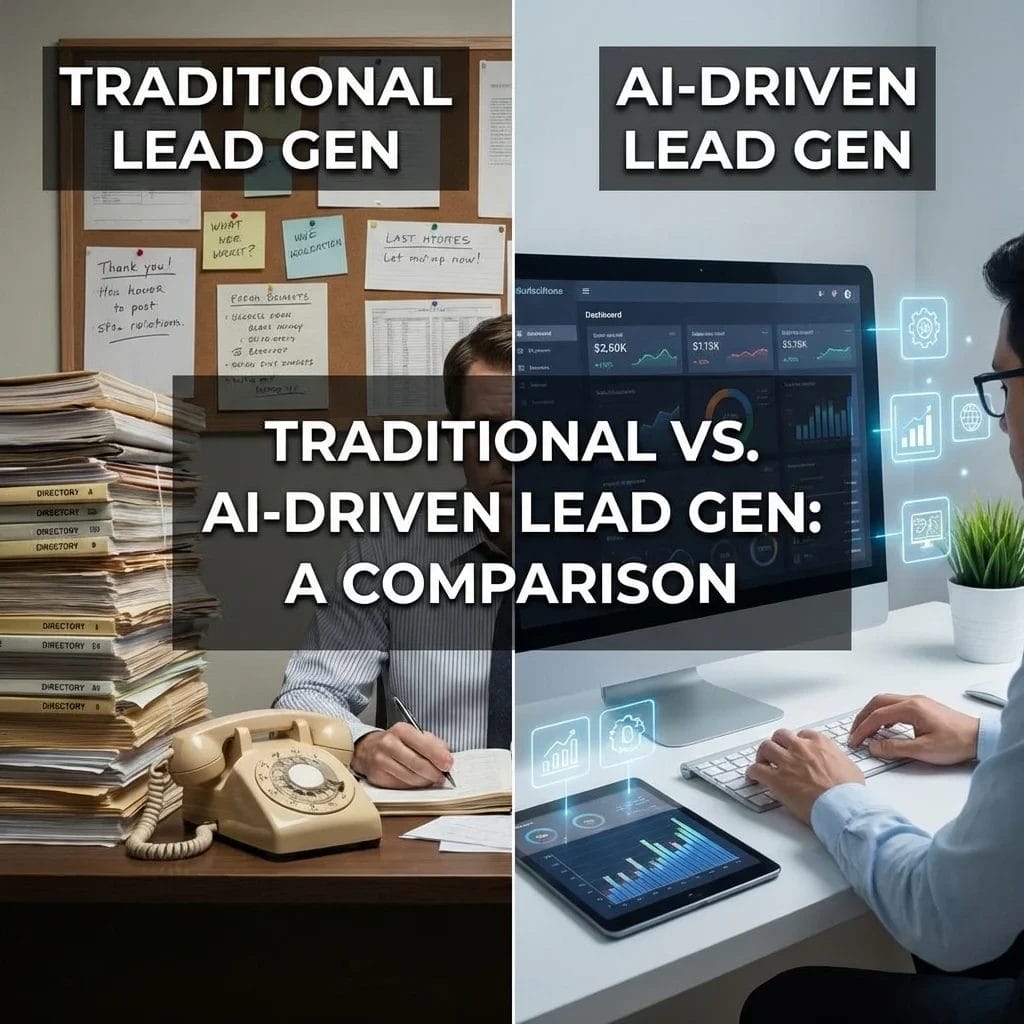
Comparison: Traditional vs. AI-Driven Lead Gen
| Feature | Traditional Lead Gen | AI-Driven Lead Gen (2026) |
|---|---|---|
| Data Source | Static, purchased lists | Real-time intent & first-party data |
| Personalisation | Templates with [Name] tags | Deeply researched, bespoke messaging |
| Speed | Manual (Hours/Days) | Instant (Seconds/Minutes) |
| Lead Quality | Quantity over quality | Predictive “Ready-to-Buy” scores |
| Effort | High manual labor | High strategic oversight |
Leading AI Lead Generation Tools in the UK Market
- CRM & Orchestration: Salesforce Einstein (predictive scoring), HubSpot Breeze AI (automation and copilot features).
- Engagement & Chat: Drift and Intercom for conversational lead qualification.
- Data & Intent: ZoomInfo for data enrichment and 6sense for identifying hidden buyer intent.
- Content & Outreach: Jasper for content creation and Apollo.io for automated, personalised outreach.
My Answers to your Questions
How does conversational AI impact B2B lead generation in the UK?
Conversational AI reshapes the sector by enabling instant, 24/7 engagement. Recent reports show that the UK conversational AI market is experiencing significant growth as businesses adopt these tools to streamline operations and enhance customer service.
What is the adoption rate of AI in UK businesses?
Adoption is accelerating rapidly. Research indicates that approximately 39% of UK businesses are already using AI in some form, with another 31% actively considering it.
Can AI really improve conversion rates?
Yes, significantly. Companies leveraging AI-powered tools often see a 35% increase in conversion rates compared to traditional methods, proving the technology’s ability to identify and nurture high-quality leads effectively.
Is AI replacing human sales teams?
No, it augments them. By automating routine tasks, AI allows humans to focus on high-value interactions. In fact, AI is transforming UK businesses by automating repetitive tasks, freeing up staff for strategic roles that require emotional intelligence.

Meet the UK’s Digital Storyteller: Journalist & SEO Developer
Did you know that websites with well-optimised SEO receive approximately 1,000% more traffic than those without proper optimisation? This striking statistic shows why having someone who understands both compelling content creation and technical SEO is so valuable.
I blend journalism and web development to create digital experiences that connect with people and rank well on search engines. After years of writing for leading UK publications, I noticed how technical limitations often held back great content from reaching its audience. So I taught myself web development, specializing in SEO-focused sites that don’t just look good but actually get found. When I’m not coding or writing, you’ll find me exploring London’s hidden coffee shops with my dog, testing new ideas on my personal blog, or speaking at industry events about the intersection of content and code.
Need someone who speaks both “journalist” and “developer” fluently? Let’s talk about how we can make your digital presence more visible and valuable.

